Gravity Always Wins: The Cold Mathematics Behind Why the Casino Beats You Every Time
There's a reason casinos don't go broke. It's not luck, it's not clever staffing, and it's definitely not because every player who walks through the door — or logs in — happens to run cold. It's maths. Pure, unapologetic, built-into-the-software maths. And no matter how fast you play, how carefully you pick your games, or how sophisticated your betting system is, that maths doesn't move.
At Casino Rocket AU, we're all about giving you the honest pre-flight briefing. So consider this your full systems check on house edge — what it actually means, how it plays out across the games Aussies love most, and why understanding it is the single most useful thing you can do before you wager a cent.
What the House Edge Actually Is
The house edge is the percentage of every bet the casino mathematically expects to keep over time. It's not what happens in any single session — short-term, anything can go. It's what happens across thousands and thousands of rounds, averaged out into a cold, hard number.
Think of it like this: if a game has a house edge of 5%, the casino expects to return $95 for every $100 wagered across its entire player base over time. That remaining $5 is the casino's guaranteed slice. You might win big tonight. Someone else loses big tomorrow. But the 5% doesn't budge.
This is fundamentally different from the idea that the casino is "cheating." It's not. The games are fair in the sense that they operate exactly as designed. The design just happens to include a permanent mathematical lean toward the house.
The Numbers Behind Australia's Most Popular Casino Games
Let's get specific, because this is where it gets real.
Pokies (Online Slots) Aussies love a pokie, and online casinos know it. Most online pokies carry a Return to Player (RTP) rate somewhere between 94% and 97%, which sounds reassuring until you flip it around. An RTP of 96% means a house edge of 4%. Spin $500 through a machine at that edge and the casino statistically expects to keep $20. Spin $5,000 and it keeps $200. The more you play, the more reliably that percentage extracts from your bankroll — and high-volatility pokies can mask this brutally, delivering long dry spells punctuated by wins that feel bigger than they are.
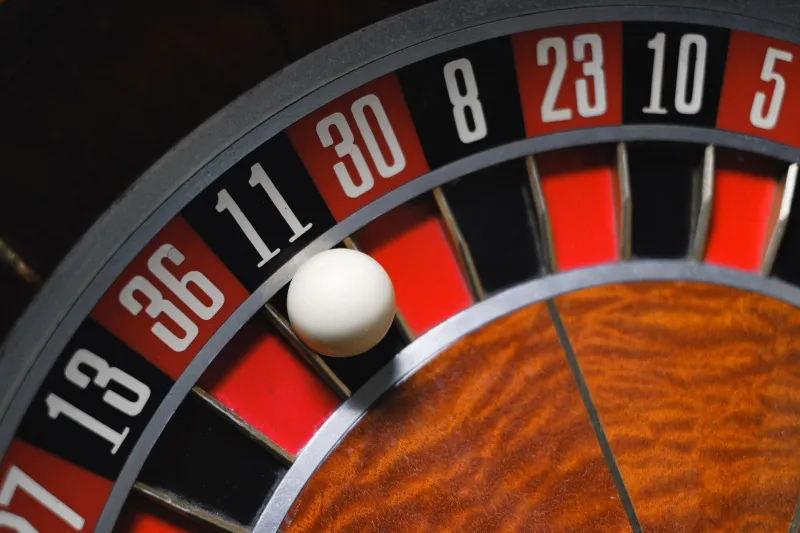
Roulette European roulette, with its single zero, carries a house edge of 2.7%. Sounds modest. But American roulette — which you'll still find at plenty of AU-accessible online casinos — adds a double zero, pushing the edge to 5.26%. That extra pocket nearly doubles the casino's mathematical advantage. Betting on red or black doesn't change this. The zero (and double zero) is the mechanism that ensures the house always collects.
Blackjack Blackjack is often cited as the casino game with the best odds for players, and that's technically true — but with serious conditions attached. With perfect basic strategy, the house edge can drop to around 0.5%. The moment you deviate from optimal play, that edge climbs fast. And "perfect basic strategy" is harder to execute consistently under real playing conditions than most people admit. The casino's edge in blackjack isn't huge, but it's still there, and it's still pointing one direction.
Baccarat Betting on the banker in baccarat gives you a house edge of roughly 1.06% — one of the lowest in the casino. Betting on the player sits around 1.24%. Sounds great. But bet the tie and you're looking at a house edge of over 14%. It's the same table, the same game, and a wildly different mathematical reality depending on where you put your chips.
Keno Keno is popular in Australian pubs and clubs, and it's migrated online with the same economics. House edges on keno can range from 20% to 35% depending on the variant. It's essentially a lottery with worse odds and faster rounds.
Why No Strategy Can Overcome the Edge
This is the part that stings. The house edge is a mathematical constant, not a variable you can outmanoeuvre. Betting systems like Martingale — where you double your bet after every loss — don't alter the underlying probability of any individual outcome. They redistribute risk. Sometimes dramatically.
The gambler's fallacy plays into this hard. Because roulette landed on black seven times in a row doesn't mean red is "due." The wheel has no memory. Each spin is independent. The house edge applies equally to every single round, regardless of what came before.
Playing faster doesn't help either — it actually accelerates your exposure to the edge. If you're running through 600 spins an hour on a pokie instead of 300, you're not improving your odds. You're doubling the rate at which the house edge extracts from your bankroll.
Game selection helps at the margins — choosing European roulette over American, or blackjack over keno, genuinely does reduce the edge you're working against. But "reduced" isn't the same as "eliminated."
The Long Run Is the Casino's Best Friend
Here's the brutal truth about probability: in the short run, variance reigns. Players win. Sessions go well. Bankrolls grow. That's real, and it's part of why gambling is genuinely entertaining.
But the longer you play, the more tightly your results converge on the mathematical expectation. This is the law of large numbers, and it doesn't care about your strategy, your lucky shirt, or your gut feeling about the next spin. Over enough rounds, the house edge wins. Every time. Without exception.
Casinos are built on volume. Millions of bets across thousands of players smooth out all that short-term variance and deliver the edge reliably to the house. Your session is one tiny data point in an ocean of results — and that ocean always flows the same direction.
What This Actually Means for You
None of this means you shouldn't play. Understanding the house edge isn't a reason to stay off the launchpad — it's a reason to fly with your eyes open.
It means setting a budget you're genuinely comfortable losing, because statistically, long-term, that's the realistic outcome. It means choosing lower-edge games if you want your money to last longer. It means treating a win as a bonus rather than evidence that your system is working. And it means knowing when to cash out instead of feeding a hot streak back into the machine.
The house always has gravity on its side. You can still have a great flight — just don't pretend the physics don't apply to you.